顯示具有 disasters 標籤的文章。 顯示所有文章

2013年1月3日 星期四

Top 10 Survival / Prepper Websites on the Internet

Caution: please judge yourself!

------------------------

If you are anything like me you have a long list of favorite survival/prepper websites that you visit everyday.  Each site has its own qualities with respect to appearance, community of followers and specific techniques for trying to reach the public.  With that in mind I decided to rate as many of these sites as possible in order to come up with a top 10 list.  Before I get into the criteria I should mention what made me immediately rule out any of the contenders.  If I logged onto the home page of any one site and was immediately greeted by an annoying pop up ad it was off the table.  I hate pop up ads, and by that I mean I despise them.   That being said let’s get on the with the criteria which I used to review each site.

Initial Appeal:  This happens within the first 3 seconds of visiting a site.  I formulate an immediate impression as to how good/bad I think a site will be mere seconds after visiting a site and you do it as well.  Are the eyes greeted with a pleasing color?  Is it possible to identify within that first 3 seconds what the site is about, or must one dig around through a bunch of strange links and banner ads?  Did someone get overzealous with widgets in addition to .gif ads (bombarded with flashing images) or is there a nice conservative mix of images and text? Like the old phrase goes, you never get a second chance to make a first impression.   There might have been a site out there with ridiculous amounts of information, a prepper’s dream website, but if I couldn’t get past the first 3 seconds it didn’t have a chance.  Think recruiter with a stack of 500 resumes to go through, each one gets about 3 seconds of consideration before going into the “take a second look ” pile or the trash.

Layout / Navigation:  When you load a page on a site your eyes naturally move from the top left of the page to the right.  Additionally what’s “above the fold” (what you see before you have to scroll down) is most the important content on the page when considering what type of  initial impression it leaves on the visitor.  That said what I’m looking for is ease of navigation, does the information on the page flow or is it a jumbled pile of links and images?  There is nothing wrong with ads but are they placed neatly on the page and are their sizes consistent, or did the website owner not even take the time to standardize the banner sizes (thus leaving the page looking sloppy).  Does the page render properly in IE, FF and Chrome?  Links to other pages or categories should be laid out consistently and easy to find, in the world in which we live if someone cannot find what they are looking for withing 3-5 seconds they are off the page and onto something else.

Relevant Content:  Not only related to survival / prepping, but also as far as variety is concerned.  There should be a good mix of all topics, not just homesteading, or guns and ammo.  Posts should be informative and not random, i.e.  ”I had Applebees for dinner!”  The website NAME should be relevant which alludes to what the site is about.  I should also mention if I click on a link and it gets redirected to yourwebsitename.blogspot.com that’s a no-go right off the bat.  The domain name should correlate with what is displayed on the home page.

Post Frequency:  Preferably there would be updates or new articles daily, but 3-4  times a week still gets a decent score.  If not daily there should definitely be a consistent manner with which updates are made (i.e. every Wed and Sat).  Posting at random is the best way to lose readers because you have to keep them guessing as to when the next post will be.  There are some sites that are more a repository of information rather than daily blogs, and depending on the relevance of the info (and scope) they indeed have a shot of making the list (and some do).
Speed Test:  This one purely data driven, no subjectivity.  I simply went to IWebTool.com,  typed in all of the website addresses I was grading and waited for the results.  A load time was displayed in seconds, which helped to drive the score.  Click here for a screenshot of the test results (note that the order is random).

The Top 10 Survival / Prepper Websites on the Internet

1-Survivalblog.com:  The standard by which all other sites are judged.  JWR’s site is updated daily and his published writing contests bring in a variety of experience of knowledge from all around the globe.  The design is a bit “plain jane” but the information is easy to access and the layout is pleasing.  New and seasoned preppers could visit this site and literally spend hours learning and downloading relevant information.  While this site did have the slowest load time of the bunch, I can only speculate that is because of the sheer amount of data stored on the server and possibly because their server is located in Sweden.

2-SHTFBlog.com:  Another three column blog which loads quickly, has a clean layout and immediately lets you know what the content of the site is about.  Three contributors to the blog give it some great variety and all of the other relevant information (there is lots of it) is easily accessed from links on the right side of the page.  There are quite a few ads but they aren’t “in your face” and are all standardized when it comes to size.

3-TheSurvivalistblog.net:  A very clean website (think google), very minimalistic when it comes to colors (black and transparent) but it works well.  Lots of great information on the site which is very easy to access, and a very active community which contributes in a way which is productive (no internet fights and insults allowed).   Content beyond what is displayed on the main page is easy to access, and the ads are clean and standardized.

4-AmericanPreppersNetwork.com:  A combination website, blog, forum, store and gathering place for preppers from all around the USA.  Tons of relevant information is available via articles written by members, podcasts and videos.  Additionally if one would like to link up with like minded individuals near a specific area this site can help to facilitate that.

5-OffGridSurvival.com:  One of the few sites where a dark theme/layout works well.  Drop down menus above the fold allow the user to quickly access information, with relevant links to the latest articles a popular topics flowing down the right side of the page.  The main page of this site is great, although it doesn’t follow the typical blog (daily update) format it has snapshots of articles from many different categories (outdoor, survival, news, off grid, hunting etc).  I like not having to dig around for information and this site delivers nicely.

6-SurvivalCache.com:  This site is very similar to offgridsurvival.com in that it does not follow the traditional daily update format.  However the sheer amount of information available on the main page along with a very orderly and pleasing layout make this site worth visiting.  I love the fact that on the main page there are no banner ads, very nice indeed.  The site also has a newsletter you can subscribe to and a forum community.

7-GreatNorthernPrepper.com:  A very clean website with an awesome collection of dropdown menus right below the main banner.  You don’t even have to scroll down on the page to find specific articles by category, simply hover over each main topic (e.g. food preps) and a drop down menu is displayed (sometimes with subcategories) which allow you to quickly access information.  There is a link titled New Preppers which is a great thing to have considering how many people are “waking up” these days.  Some of the ads did not render properly when I had the page up (or show up at all), small deductions there but nothing major.

8-TheSurvivalMom.com:  It’s quite obvious that someone with website design skills put this site together, the layout is great and the colors compliment each other nicely.  While content is king this site goes about pleasing the eye quite nicely as well.  Once again dropdown menus are utilized to help the user quickly access relevant information, with recent posts updated quite often just below the fold.  I like the link to “the basics” which is a great place for any new prepper to start.  The ads are clean and out of the way, although one image showed a broken link.  If I had to be picky, I’d wonder why the contact form was displayed in the footer, but that’s just me.

9-SHTFPlan.com:  A great site which offers a mix of survival/prepper articles in addition to daily news (heavy on the news).  This website is updated many times a day with articles and videos.  A clean layout which is easy on the eyes and tons of relevant links down the side of the page to other great websites are a bonus.  The *only* downside to this site is that specific survival/prepper categories (e.g. food storage, water, guns) are not displayed on the front page, but since there are so many articles all you have to do is a search and you are bound to find something worth reading.

10-PrepperWebsite.com:  Not a blog and not particularly at the cutting edge of website design, but nonetheless it’s place on the list is well deserved.  A no frills website which won’t win any design awards however the sheer amount of data compiled on this site is quite impressive.  Think of it more like an information portal where you can not only see the best daily updates from around the web but also access other relevant sites (which are divided by type).  There is also a link to The Preparedness Review (TPR) an insanely popular eReview put together and published by the owner of Prepperwebsite.com.

So there you have it, the list in its entirely and the criteria which was used to create it. What are your thoughts? Do you agree or disagree and did I miss one of your favorites?

***

This article appears courtesy of Prepper-Resources.com, one of the premier prepper/survival blogs online today. Whether you are a new or experienced prepper feel free to visit and check out all of the other valuable information posted there.

Source : 2012 Glorious Hope - Soli Deo Gloria: Top 10 Survival / Prepper Websites on the Internet


70 Things That Can and Will Go Wrong in a Disaster


As hip as it may sound to talk about zombies, the end if the world and a doomsday apocalypse, the reality is that a disaster is anything but cool and hip.  As we look back in modern history, we will find countless instances where a disaster, whether man-made or a freak of nature, has wreaked unexpected havoc, destruction and panic.  The recovery process is long, and the level of organization and dedication required to successfully mobilize resources is huge.

That brings me to the topic of today’s article: “70 Things That Can Go Wrong in a Disaster”.

I recently came across a listing of things that can go wrong during and following a disaster and while the list is not my original work, I felt that it was a list worth sharing.  Some of the points are common knowledge, but others were surprising and to be honest, a bit disconcerting as well.  Most of the 70 items are negative and many go against what we commonly believe will occur as first responders and rescuers come on the scene.

So what is a prepper to do?

Read through the list, remind yourself that trained personnel are human too, and that even with the best of training, mistakes will be made.

Things that will go wrong in a disaster
7185815015 e5b5caae1a n 70 Things That Can and Will Go Wrong in a Disaster   Backdoor Survival1. In an earthquake, there may be violent ground shaking; it will seem to last much longer than it actually does.
2. Fires will occur, caused by electrical shorts, natural gas, fireplaces, stoves, etc.
3. Fires in collapsed buildings will be very difficult to control.
4. The extent of the disaster will be difficult to assess, though this will be necessary to assure proper commitment of resources.
5. Emergency equipment and field units will commit without being dispatched. There will be an air of urgency and more requests for aid than units available to send.
6. Communications will be inadequate; holes will appear in the system and air traffic will be incredibly heavy.
7. Trained personnel will become supervisors because they will be too valuable to perform hands-on tasks.
8. Responding mutual aid units will become lost; they will require maps and guides.
9. Water will be contaminated and unsafe for drinking. Tankers will be needed for fire fighting and for carrying drinking water.
10. Citizens will volunteer but their commitment will usually be short-term.
11. There may be a multitude of hazardous materials incidents.
12. Aircraft will flood the area; law enforcement, fire, media, civilian, commercial and military aircraft will be a major concern.
8258876947 fa7178a16b o 70 Things That Can and Will Go Wrong in a Disaster   Backdoor Survival13. The Command Post and/or EOC will be overrun with non-essential personnel; media, geologists, architects, engineers, representatives from other jurisdictions, etc.
14. Staging will be essential; the flow of personnel, equipment and supplies will be overwhelming.
15. Although it is an EOC function, the Field Command Post will become the temporary seat of government.
16. Electric power will be interrupted or will fail completely.
17. It will be difficult to shut off the gas; valves that are seldom, if ever, used will be difficult to find, and may not work when they are found.
18. Phone service will be erratic or non-existent. Pay phones will be the most reliable.
19. The media will have the best communications available; be prepared to share or impound their resources.
20. Fuel will not be available because there will be no electricity to run the pumps.
21. There will be an epidemic of flat tires; police, fire, and emergency medical vehicles will sustain a multitude of flat tires that will require repair in the field.
22. Fires will need to be investigated; mutual aid should include arson investigators.
23. The primary police department concern will be law enforcement; there will not be sufficient time or manpower to provide miscellaneous services.
24. It will be dark; there will not be enough generators or lights available.
25. Portable toilets will be in demand; there will be no place to go, and if a place is found there will be six photographers there to cover the event.
26. The perimeter will be difficult to control; citizens and media alike will offer good reasons why they should be allowed to enter the restricted area.
27. Search dogs will be needed early in the operation.
28. Documentation will be very important; there will be a multitude of requests for information later.
29. Riveted steel (oil and water storage) tanks may fail.
30. Streets will be impassable in some areas; it will be necessary to clear streets of rubble in order to conduct emergency operations.
31. The same buildings will be searched more than once unless they are clearly marked.
32. In earthquakes, there will be after shocks; they will hamper emergency operations, create new fears among the citizenry and may cause more destruction than the original shock.
33. Many injured people will have to find their own way to medical treatment facilities.
34. Volunteer and reserve personnel may be slow to respond; they will put their own families’ safety first.
35. On-duty public safety personnel will be concerned about their own families, and some may leave their posts to check on them.
36. Law enforcement and the media will clash; all media representatives should be referred to the Public Information Officer.
37. Very few citizens will utilize evacuation/mass care centers; they will prefer to stay with friends and relatives, or to camp out in their own yards.
38. Structural engineers will be needed to evaluate standing buildings for use as evacuation centers, command posts, information centers, first aid stations.
39. The identification of workers and volunteers will be a problem; it will be difficult to determine who is working where and on what.
40. There will be rumors; people will be listening to their radios and must be given accurate information.
8259923444 6baf8b8978 o 70 Things That Can and Will Go Wrong in a Disaster   Backdoor Survival41. There will not be enough handie-talkies; batteries will soon go dead.
42. Many fire hydrants will be inaccessible (covered or destroyed by rubble) or inoperable.
43. Generators will run out of fuel; jerry cans of fuel must be obtained early to maintain generator powered lighting and communications.
44. Critical facilities will have to be self-sufficient; gas, lights, water and sewage may be out for days.
45. Emergency responders will require rest and must be relieved. Local personnel may be of value as guides for mutual aid responders, or as supervisors for volunteer crews.
46. Equipment will be lost, damaged or stolen, and may never be accounted for.
47. Someone will get the bill; record-keeping and accounting procedures will be important.
48. Traditional non-emergency personnel will want to go home at 5 o’clock; all public employees must be made to realize that they are a part of the emergency response team.
49. People will die and there is nothing that can be done about it. Non-public safety personnel will not understand why everyone cannot be saved. Priorities must be set to save the most lives possible.
50. Dead bodies should not be an initial concern. Rescuing the living should be the first priority.
51. If phones are working, the number of requests for service will be overwhelming. People will have to fend for themselves; it will be difficult for dispatchers to ignore these pleas for help.
52. Some field units will disappear; you will not be able to reach them and will not know where they are or what they are doing.
53. Security will have to be posted at hospitals, clinics, and first-aid stations to control hysterical citizens demanding immediate attention.
54. Representatives from public agencies throughout the United States and many foreign countries will want to come and observe the operations or offer assistance. They will be a significant problem.
55. Department heads (EOC) staff may not have a working knowledge of their assigned areas of responsibility, and will play it by ear.
56. Some citizens and media representatives will question your decisions because they will not recognize that the safety of field responders is paramount.
57. There are no critically injured in a disaster; only those who are dead or alive.
58. Handicapped and disabled persons will probably die unless personal family and friends can care for them and maintain their life-support systems.
59. Management will not be familiar with field response procedures, and may attempt to change standard operating procedures.
60. Emergency responders (public safety and medical alike) will not be adequately trained to respond efficiently.
61. There will be initial chaos; supplies, materials and equipment needed will not be readily available.
62. There will be a general lack of necessary information; coordinators will want to wait for damage/casualty assessment information to establish priorities.
63. Emergency equipment will not be able to reach some locations because of traffic jams. Tow trucks will be at a premium. Parked or abandoned vehicles will block streets, and emergency responders will be the worst offenders.
64. Even though there will not be enough people to initially deal with emergencies, many available personnel will never be identified and never used. After the initial shock, there will be too many volunteers.
65. General information will be offered in response to specific questions because field units cannot verify the requested information.
66. Individual public safety officers will be asked to do the work of squads or companies; they will have to recruit volunteers on the spot to provide assistance to their efforts.
67. The message flow to, from, and within the EOC and Field Command Post will break down and become inefficient and unmanageable.
68. There will be an over critical desire to verify all incoming information. If it is received from a field unit, it should be considered as verified.
69. Some EOC and Command Post personnel will become overloaded; some will not be able to cope with the volume of activity and information they have to deal with, and some will not be able to cope with the noise and distractions.
70. Things will get better some time after they have become considerably worse.

Credit for this list:  A July 6, 2006 article by Lt. Dan Blackston, Chula Vista Police Department

As you read through this list of 70 things that can go wrong following a disaster, realize that while many of these things may not happen each and every time there is an emergency, many of them will indeed occur.  And it is true.  Things will get better – eventually – but they may also get a lot worse than you can imagine before the road to recovery begins.

As a layman citizen, think about your own needs now and how they might be impacted in an emergency.  Recognize and acknowledge up front that if things can go wrong, they will.  Go back and re-visit your most basic prepping skills and supplies by reviewing 12 Months of Prepping.  And of course, continue to stow away extra food, water and especially tools that will help get you through if a disaster occurs in your community. Couple that with basic outdoor skills and a bit of faith and you will have done your best to prepare.

Enjoy your next adventure through common sense and thoughtful preparation!


Source : 2012 Glorious Hope - Soli Deo Gloria: 70 Things That Can and Will Go Wrong in a Disaster


2012年11月20日 星期二

“Frankenstorm” Sandy: Man Made By HAARP Or An Act Of God ?


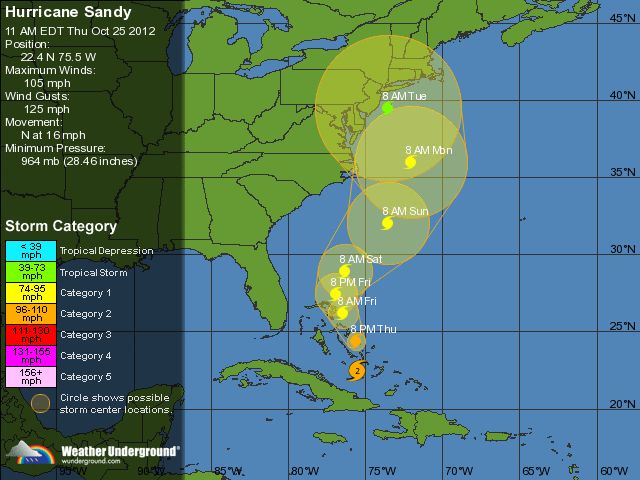
Is Hurricane Sandy being steered to the East coast of the United States using the weather modification technique known as HAARP ? The government has dubbed this storm ‘Frankenstorm’. Sure connotates a ‘man made monster’, doesn’t it? We’ve been reporting all week that HAARP has been nailing us here in the mid-Atlantic region up to New England.


From Yahoo:  Government forecasters say a big storm that they’re calling “Frankenstorm” is likely to blast most of the U.S. East Coast next week.


What they’re not telling you is that this was ‘the plan’, an epic storm that could put things all along the eastern seaboard ‘on hold’ for a while. Listen to the forecast below. The ‘perfect storm’ is approaching. Man made or an act of God? Buckle up! We could be in for a wild ride!


Source : “Frankenstorm” Sandy: Man Made Monster Or An Act Of God? 


2012年11月19日 星期一

Some Lessons That Preppers Can Learn From Hurricane Sandy


Here's an article on how to prepare for a hurricane like Sandy. Time to think more about how we can prepare for 2012...

~~~~~~~~~~~~~~~~~~~~~~~~~
If you are just starting to prepare for Hurricane Sandy, the truth is that you are already too late.  Most of the essential supplies have already been stripped from store shelves.  If you don't have an emergency generator, you might be without power for quite some time.  It is being estimated that up to 10 million people could lose power during this storm, and it is already being projected that some people may end up being without power for a week or more in the worst hit areas.  Hopefully you have already boarded up your windows.  They can be broken very easily during a hurricane, and you certainly don't want to be dealing with a broken window during the worst moments of the storm.  Those that have prepared ahead of time are likely to be in good shape to ride this storm out, but sadly the reality is that most people have not prepared ahead of time.  Every time a major storm or natural disaster strikes, we always see the same thing happen.  Hordes of half-crazed people storm into the stores hoping to find the things that they need, and many of them end up leaving disappointed because what they were looking for has already sold out.  Thankfully, most of our "disasters" have typically only lasted a few days at most, but what will happen someday if a disaster ends up being permanent?  What if there is a disaster that is so bad someday that things never return to "normal"?  Would you and your family be able to survive on only the preparations that you have made so far?
Hopefully Hurricane Sandy will be a wake up call for a whole lot of people.  It is being projected that this storm will affect about 50 million Americans, and it is already been called "worse than Katrina" by some meteorologists.  It is an absolutely gigantic storm.  It is more than 1000 miles across and it is the largest hurricane to hit the U.S. since records of storm size began to be kept back in 1988.  According to the National Oceanic and Atmospheric Administration, the destructive potential of this storm is rated 5.8 on a scale that goes from 0 to 6.  So needless to say, referring to this storm as "the Frankenstorm" does not quite do it justice.  It is being touted as the worst storm to hit the east coast in 100 years.
According to Stu Ostro, a senior meteorologist at the Weather Channel, this is truly a history making storm...

"History is being written as an extreme weather event continues to unfold, one which will occupy a place in the annals of weather history as one of the most extraordinary to have affected the United States."
So a lot of Americans are about to find out exactly how prepared they really are for a major natural disaster.
High winds of 80 MPH or higher are going to take down power lines all over the northeast over the next few days.  Along the coast, some people could see a storm surge that is up to 15 feet above sea level in some areas.  Other areas will see nightmarish flooding as a result of very heavy rain.
So there will certainly be a lot of challenges.  The good thing about a hurricane is that you typically have at least a few days in advance to make preparations.  Hopefully people have been making good use of the time.
Unfortunately, most Americans do not even have a short-term supply of food and water stored up.  A lot of people run out to grab some food and water from the stores at the last minute, only to find that there is none left.
For example, it is being reported that store shelves all over New York City have already been picked clean of bread and other essentials.
In Arlington, Virginia it is being reported that some supermarkets are already sold out of water.  If the worst happens and some people end up spending a week without tap water they are really going to wish that they had made some preparations ahead of time.
But food and water are not the only things in high demand.
According to CNN, other emergency supplies have been flying off the shelves as well...

Generators, flashlights, water, batteries -- these are just some of the emergency supplies that are running out in many stores in the Northeast.
Nearly a third of the country's northeast is preparing for Hurricane Sandy, which expected to make landfall on Sunday and Monday. Customers who have been flocking to stores may be coming home empty handed.
Fortunately this is only a temporary emergency, but what if we have a "permanent" emergency someday?
What will people do if they can't find the things that they desperately need all of a sudden?
According to Fox News, one store in Ohio is reporting that people are actually calling from other states to see if they still have any supplies...

An assistant manager at a Lowes store in Columbus, Ohio, told 10TV.com that people were calling in from West Virginia and Maryland to ask for supplies.
And in northern Virginia, a cashier at Pitkins Ace Hardware in Dale City said batteries, flashlights and candles were flying off the shelves, PotomacLocal.com reports.
When will people learn?
You don't wait until the last minute to get necessary emergency supplies like plywood, hurricane shutters, tarps, sump pumps, ice chests, candles, flashlights, batteries and battery-powered radios.
For a hurricane, you need to be prepared to be able to survive for at least a week without any help from the outside world.  In the most extreme situations (such as in the aftermath of Hurricane Katrina) the state of emergency created by a hurricane can last even longer.
So exactly how should one prepare for a hurricane?
Ready.gov provides the following list of tips...
To prepare for a hurricane, you should take the following measures:
  • To begin preparing, you should build an emergency kit and make a family communications plan.
  • Know your surroundings.
  • Learn the elevation level of your property and whether the land is flood-prone. This will help you know how your property will be affected when storm surge or tidal flooding are forecasted.
  • Identify levees and dams in your area and determine whether they pose a hazard to you.
  • Learn community hurricane evacuation routes and how to find higher ground. Determine where you would go and how you would get there if you needed to evacuate.
  • Make plans to secure your property:
  • Cover all of your home’s windows. Permanent storm shutters offer the best protection for windows. A second option is to board up windows with 5/8” marine plywood, cut to fit and ready to install. Tape does not prevent windows from breaking.
  • Install straps or additional clips to securely fasten your roof to the frame structure. This will reduce roof damage.
  • Be sure trees and shrubs around your home are well trimmed so they are more wind resistant.
  • Clear loose and clogged rain gutters and downspouts.
  • Reinforce your garage doors; if wind enters a garage it can cause dangerous and expensive structural damage.
  • Plan to bring in all outdoor furniture, decorations, garbage cans and anything else that is not tied down.
  • Determine how and where to secure your boat.
  • Install a generator for emergencies.
  • If in a high-rise building, be prepared to take shelter on or below the 10th floor.
  • Consider building a safe room.
A recent CNN article included a list of supplies that you should have on hand in the event that a hurricane is on the way...


-- A three-day supply of water, one gallon per person per day.
-- Three days of food, with suggested items including: canned meats, canned or dried fruits, canned vegetables, canned juice, peanut butter, jelly, salt-free crackers, energy/protein bars, trail mix/nuts, dry cereal, cookies or other comfort food.
-- A can opener.
-- Flashlight(s).
-- A battery-powered radio, preferably a weather radio.
-- Extra batteries.
-- A first aid kit, including latex gloves; sterile dressings; soap/cleaning agent; antibiotic ointment; burn ointment; adhesive bandages in small, medium and large sizes; eye wash; a thermometer; aspirin/pain reliever; anti-diarrhea tablets; antacids; laxatives; small scissors; tweezers; petroleum jelly.
-- A small fire extinguisher.
-- Whistles for each person.
-- A seven-day supply of medications.
-- Vitamins.
-- A multipurpose tool, with pliers and a screwdriver.
-- Cell phones and chargers.
-- Contact information for the family.
-- A sleeping bag for each person.
-- Extra cash.
-- A silver foil emergency blanket.
-- A map of the area.
-- Baby supplies.
-- Pet supplies.
-- Wet wipes.
-- A camera (to document storm damage).
-- Insect repellent.
-- Rain gear.
-- Tools and supplies for securing your home.
-- Plastic sheeting.
-- Duct tape.
-- Dust masks.
-- An extra set of house keys.
-- An extra set of car keys.
-- An emergency ladder to evacuate the second floor.
-- Household bleach.
-- Paper cups, plates and paper towels.
-- Activities for children.
-- Charcoal and matches, if you have a portable grill. But only use it outside.

But in the final analysis, preparation is going to look a little bit different for every family.
If you live along the coast, there is a good chance that you will need to evacuate.  If you live farther inland, you will probably be able to hunker down exactly where you are.
Hurricane Sandy will come and go, but hopefully millions of Americans will learn some lessons about preparation from this crisis.  One of these days we may have a disaster that lasts much longer such as a major economic crisis, an EMP attack, a nightmarish pandemic or a major war.  If we cannot handle a disaster that lasts for just a couple of days, what chance are we going to have at surviving something that lasts for months or even years?
That is something to think about.  Hopefully we will all reflect on emergency preparedness over the next few days.  Our world is becoming increasingly unstable, and eventually there will come a point where we will find ourselves totally dependent on the preparations that we have made.
Original article at http://endoftheamericandream.com/archives/how-to-prepare-for-a-hurricane-some-lessons-that-preppers-can-learn-from-hurricane-sandy?utm_source=rss&utm_medium=rss&utm_campaign=how-to-prepare-for-a-hurricane-some-lessons-that-preppers-can-learn-from-hurricane-sandy


A huge explosion has been filmed at a power plant in downtown Manhattan after Hurricane Sandy made landfall.


~~~~~~~~~~~~~~~~~~~~~~~~~~~~~~~~~~~~~~~~~~~~~~~~~~~~~~~~~~~~~


TOTTENVILLE — They fly into disaster areas, but flee from raindrops.

FEMA disaster recovery centers in Hurricane Sandy-ravaged sections of the city that were supposed to provide assistance to hurricane victims went MIA Wednesday morning, posting signs saying that they were closed due to the approaching Nor'easter.

The temporary shuttering of the facilities, which help victims register for disaster relief, as well as city food distribution centers come even as many of those still reeling from the monster storm were not told that they had to leave the battered areas.

“We do not believe that it’s necessary to evacuate people,” said the mayor Wednesday.

The move left residents of the storm-ravaged areas fuming.

"The storm is coming. We don't know how hard it's going to hit us," said Jenny Cartagena, 46, who found the FEMA center in Coney Island closed Wednesday when she went there looking for food. "I need some help now."

Because the FEMA centers were located with food distribution and warming services, some residents who arrived there were confused by the closed centers.

The city's food distribution centers, a lifeline for the thousands left without power, heat and water for more than a week, would only be operating until noon Wednesday, Mayor Michael Bloomberg announced.

And the National Guard, which was handing out food and water in Coney Island also shut down at 1:30 p.m. because of the weather, but continued handing out water to the line of approximately 30 people.

A spokemsan for the New York National Guard, Eric Durr, said that he could not comment on that specific instance but "we instructed our troops to pay attention to the weather and don’t take unecessary risks." Still, he said the guard would continue to provide relief as long as was needed.


In Staten Island, a printed paper sign taped to the front door of on the center at 6581 Hylan Blvd. at 10:30 a.m. read “FEMA Center Closed Due to Weather.”

The front doors of the disaster recovery center, which is housed inside the Mount Lorretto Catholic Youth Organization, were unlocked, but there was no staff anywhere in sight for at least a half an hour.

And a set of buses which served as a pair of warming centers at the site for the past several days were missing, according to non-FEMA volunteers who continued to hand out supplies from a nearby building despite the storm.

Volunteers at a nearby donation distribution center said the buses vanished on Wednesday.
“FEMA packed up and left,” said Louis Giraldi, 47, a volunteer handing out cleaning supplies to victims.

“We don’t know where they are, so there’s nothing here but us.”

The site is listed on FEMA's list of NYC recovery centers, and was supposed to be open from 8:30 a.m. to 8 p.m. Wednesday. The site was also included in the city's list of warming facilities supposed to open at 9 a.m. on Wednesday at the site.
Unbelievable: Ginny Flanagan, 70, who lives in Breezy Point in Queens, New York returns to her damaged home in the devastated neighbourhood


A FEMA R/V also sat empty next to the recovery center.

A pair of FEMA workers alarmed by a reporter's camera came out of the building at 11 a.m. and took the sign down, saying the center reopen at 12:30 p.m. Wednesday.

The worker declined to give his name and would not explain why the site was closed or why the buses were missing.

FEMA spokesman Carter Langston said that the mobile centers were shuttered and staff moved inland because they were not structurally sound enough to weather the storm, which could put their staff in danger.

"Because these are mobile centers, they were shut down for life safety," Langston said. "As soon as weather permits tomorrow, they’re going to be back in place [possibly by noon]."
The remaining five sites in the city — in Staten Island, Coney Island, the Rockaways and The Bronx — were also closed or in the process of shutting down.

In Coney Island, a sign written in red ink that was bleeding from the rain sat on a police barrier in the parking lot of Our Lady of Solace Shrine Church on West 17th Street and Mermaid Avenue.

"They didn't want to get their precious van wet," quipped a church volunteer.

Cartagena, an asthma sufferer, said she showed up to the site with her home health aide, Camilla Suriel, 49, and her son's grandfather, Nelson Otero, 72 expecting "at least water."
"Something, you know, help," she said.

Volunteers at the church were still giving away water and MTA buses were on site to help people.

Serkan Yalcin, whose apartment in Sheepshead Bay was wrecked by Sandy, had a friend drop him off there.  He applied online for FEMA assistance last week, and came to the center today to follow up with an actual FEMA rep after his wife was not able to get through to reps.

"I would like to know if my application is in the system or not," he said. "Nobody has called or shown up."

The situation was similar in Queens, where thousands remain without power more than a week after Sandy.

At the FEMA site on Rockaway Point Boulevard, near Barrett Street, a sign read: “Operations stop [Tuesday] at 4 p.m. Closed Wednesday 7 Nov.”

The plan was to move the tent to the 99th Regional Support Command Center for Army reservists there, but because the building had no power the move could not be made until Thursday, a rep for the command center said.

Warren Lehner, 57, a project manager, lives right across the street from where the FEMA shelter has been registering hurricane victims the past 10 days, said he will likely need help for his parents, who have up to four feet of flooding in their home.

And he said with the nearly the entire peninsula going on their tenth day without power, food hard to come by, and water not running a large portion of the houses, the FEMA tents draw in much-needed volunteer efforts that established themselves around the relief centers.

“Now we got another storm coming in, where everyone’s going to be scrambling just to find a place they don’t freeze to death,” Lehner said. “Where are you going to go for a hot meal? It’s coming down to people just trying to survive, and that’s just not how it should be.”

Another location that was listed on FEMA's website on Beach 116th Street and Beach Channel Drive, showed no signs of the agency's presence.

At the city's Miller Field Distribution Center on New Dorp Lane in Staten Island, which houses a mobile FEMA disaster recovery center was also shutting down on Wednesday morning, a police car blocked the entrance at 11:35 a.m.

A cop said that officials were evacuating it because of the storm.

And in The Bronx, a FEMA tent and trailer sitting behind a volunteer firehouse on Adee Avenue in The Bronx was packed up Tuesday ahead of the storm.

"Theres's a ton of equipment you want to protect to make sure it's doing the most good wherever you take it," said Jim Garvey, of the Edgewater Athletic Association, which shares a building with the firehouse.

Read more: http://www.dnainfo.com/new-york/20121107/tottenville/staten-island-fema-disaster-center-shuts-doors-due-weather#ixzz2BebwZoFT

Volunteering: Fabrizzio Avila, 15, bundles up from the cold as he rests near donated clothing in the Midland Beach neighborhood in Staten Island, New York

Source:
How To Prepare For A Hurricane? Some Lessons That Preppers Can Learn From Hurricane Sandy :
2012 Glorious Hope - Soli Deo Gloria: FEMA Disaster Centers Shut Doors 'Due to Weather':